The Evolution of Computer Literacy in Pakur Since 2017
When CT Training Centre first opened its doors in Bank Colony, Pakur, in 2017, computer education across the district was at a critical crossroads. While the demand for basic digital literacy was expanding rapidly across government departments, small businesses, and academic institutions, access to genuine, hands-on workstation practice remained scarce. Many young people in the region had completed schooling with theoretical knowledge of computers but had rarely spent continuous hours operating software, troubleshooting errors, or producing commercial documents independently.
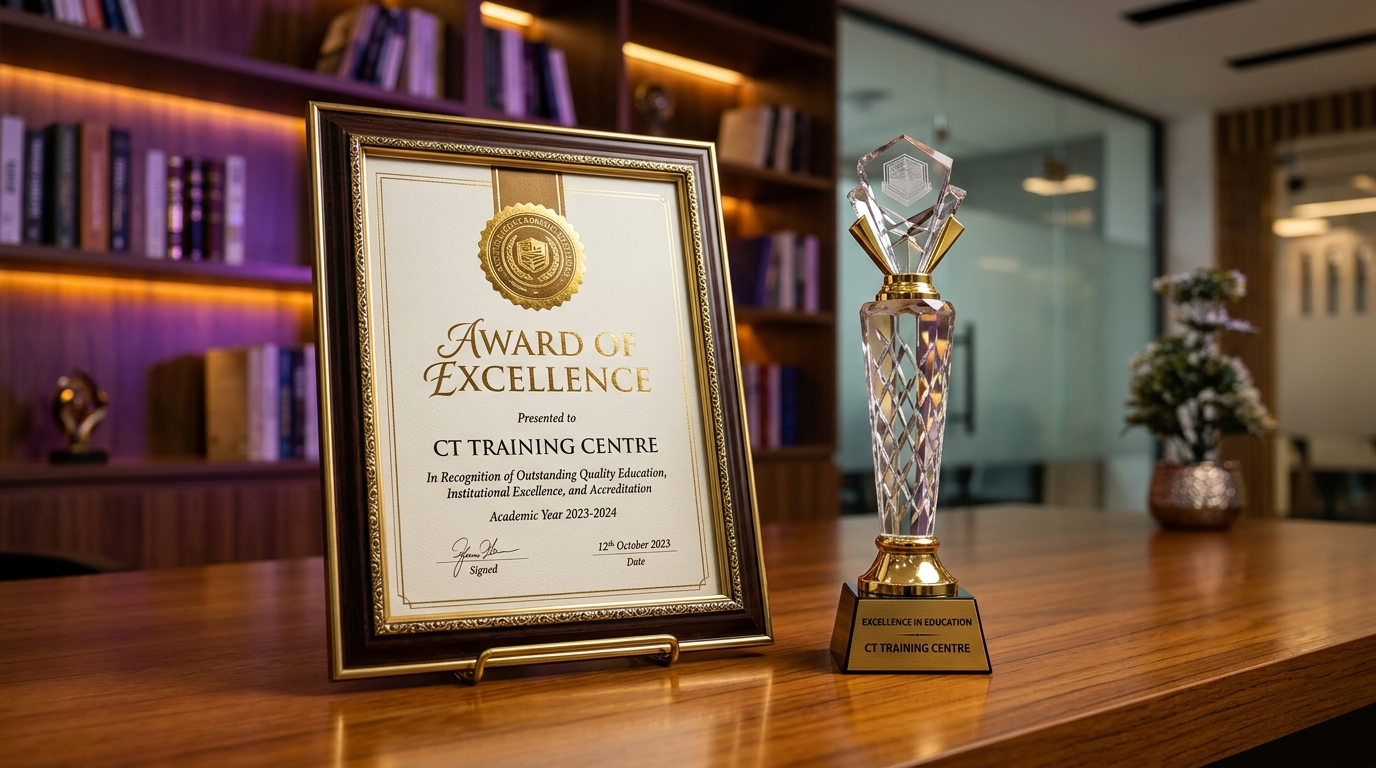
Recognizing this fundamental disconnect, CT Training Centre established a core pedagogical commitment from its inception: practical workstation training must take precedence over passive blackboard instruction. Over the past nine years, this steadfast focus has enabled more than 4,500 students to complete structured diploma and certificate programs. Within this operational journey, institutional recognitions associated with respected educational and industrial organizations—notably the All India Council for Professional Excellence (AICPE) and multinational technology leader BOSCH—represent significant milestones that reflect the centre's ongoing commitment to technical rigor and community empowerment.
Understanding Vocational Quality: What Industry Recognition Truly Means
In the vocational training sector, recognition is not merely a decorative accolade to be framed on an office wall; it serves as an external validation of instructional discipline, lab infrastructure, and curriculum relevance. For learners living in semi-urban and rural areas of Jharkhand, understanding the distinction between unverified marketing claims and structured institutional recognition is crucial when investing time and resources into career preparation.
Industry recognition signals that a training facility operates with standardized benchmarks. When organizations such as BOSCH—globally renowned for their century-long leadership in engineering precision and vocational apprenticeship frameworks—acknowledge excellence in skill development, it underscores the importance of practical training methodologies. It validates that the educational approach being delivered in Pakur is aligned with broader industry expectations, where problem-solving capability and software proficiency are valued far higher than rote memorization.
At CT Training Centre, recognition is treated as an active responsibility rather than a static achievement. Faculty members regularly review training modules, calibrate practical lab assignments against current workplace demands, and maintain rigorous evaluation standards to ensure that students consistently graduate with tangible, job-ready capabilities.
The Role of AICPE in National Vocational Validation
The All India Council for Professional Excellence (AICPE) operates as an established examination and certification board across India, focusing on vocational standardization, skill assessment, and technical literacy. For students at CT Training Centre, association with the AICPE examination portal provides a structured, transparent mechanism for validating their technical qualifications beyond local district boundaries.
Through standardized examinations, registered learners can benchmark their skills in office automation, financial accounting, desktop publishing, and programming against a nationally recognized syllabus. This external evaluation provides students with several distinct advantages:
- Standardized Curriculum Benchmarks: Course syllabi for programs such as the Diploma in Computer Applications (DCA) and Advanced Diploma in Computer Applications (ADCA) adhere to established national guidelines, ensuring comprehensive topic coverage.
- Transparent Verification: Prospective employers across both private and public sectors can verify student examination credentials and certificate authenticity through official online registration portals.
- Structured Examination Rigor: Rather than receiving informal certificates of completion, students sit for formal practical and theoretical assessments that evaluate their independent problem-solving skills under timed conditions.
This formal alignment ensures that a student earning a diploma in Pakur holds credentials with equivalent academic weight to learners completing technical courses in major metropolitan centres.
The Significance of BOSCH's Focus on Skill Development
BOSCH's global and national reputation in vocational training is rooted in the renowned dual-education model, which tightly integrates technical classroom learning with hands-on workshop execution. In India, BOSCH has actively supported numerous skill development initiatives, establishing state-of-the-art training centres that emphasize mechatronics, modern manufacturing, and information and communication technology (ICT) labs.
The institute-reported recognition from BOSCH for excellence in computer education and skill development highlights CT Training Centre's persistent efforts to bring high-quality technical education to the youth of Pakur. While CT Training Centre operates as an independent regional institute rather than a formal corporate branch of Bosch, the recognition serves as a testament to shared foundational values: technical precision, disciplined mentorship, and the belief that every young learner deserves access to practical tools that can transform their economic trajectory.
In regional environments like Santhal Pargana, where large corporate headquarters are distant, having a community learning centre that upholds these high standards is transformative. It demonstrates to students that world-class standards of discipline and excellence are achievable right here in Bank Colony, Pakur.
The Pedagogy of Practice: How Classroom Theory Translates to Lab Mastery
What does practical excellence look like on a daily basis within CT Training Centre? The institute's instructional philosophy is built upon three non-negotiable principles:
1. The 1:1 Computer Ratio In many conventional institutions, multiple students are frequently crowded around a single computer screen, leaving one person typing while others passively observe. At CT Training Centre, every student is assigned their own dedicated workstation for the entire duration of their lab batch. This guaranteed personal access ensures that learners develop tactile familiarity with the keyboard, mouse navigation, file management, and software interfaces from their very first week of classes.
2. Immediate Concept Application Lectures are kept concise and purposeful. When an instructor introduces a new concept on the board—such as calculating interest formulas in Microsoft Excel, configuring tax ledgers in Tally Prime, or writing conditional loops in Python—the explanation is immediately followed by guided hands-on execution. Students do not wait days or weeks for a scheduled practical exam; they apply each lesson within minutes of learning it.
3. Error-Driven Learning and Faculty Mentorship Beginners often fear computers because they worry about making irreversible mistakes. CT Training Centre's experienced faculty foster an encouraging classroom atmosphere where software errors are treated as valuable teaching opportunities. Trainers walk the lab floor continuously, answering questions, demonstrating keyboard shortcuts, and showing students how to identify and correct syntax errors, broken formulas, or misaligned document formatting.
Beyond the Certificate: Developing Workplace Independence
A common pitfall in vocational education is preparing students exclusively for an examination paper while neglecting the dynamic realities of actual workplace operations. An employer hiring a computer operator or accounts assistant rarely presents tasks in the tidy format of a multiple-choice question; instead, they hand over a stack of disorganized paper invoices, an ambiguous data table, or a customer communication that must be drafted, formatted, and emailed under a tight deadline.
To bridge this crucial gap, CT Training Centre's advanced diploma courses incorporate realistic workplace simulations:
- Commercial Accounting Simulations: Students process authentic business transactions using Tally Prime with GST, managing inventory batches, issuing credit notes, generating e-way bills, and reconciling monthly bank statements.
- Office Productivity and Reporting: Learners master advanced spreadsheet functions including VLOOKUP, XLOOKUP, nested IF statements, Pivot Tables, and automated data validation rules to produce executive-ready commercial reports.
- Speed and Accuracy Typing Drills: Daily bilingual typing practice in both English and Hindi builds the rapid words-per-minute speed and low error thresholds required for government clerical and data entry examinations.
- Digital Communications and Security: Students are trained in professional email etiquette, cloud storage workflows, file compression, digital signature protocols, and cyber hygiene to safeguard organizational data.
By the time a learner completes their training, operating office software has become second nature. This self-reliance transforms their demeanor during employment interviews, allowing them to demonstrate practical competence rather than merely citing theoretical knowledge.
How Students and Parents Can Evaluate Technical Training Quality
Choosing an educational institute is one of the most critical decisions a family can make. For parents in Pakur seeking the best career foundation for their children, CT Training Centre recommends evaluating any computer institute against five objective criteria:
- Dedicated Workstation Availability: Does the centre guarantee individual computer access for every student in every batch, or are systems shared among multiple learners?
- Practical Lab Hours: What percentage of total course time is spent actively working on computers versus sitting through textbook lectures? High-quality programs allocate at least 60% to 70% of class time to hands-on lab work.
- Faculty Experience and Lab Presence: Are trainers actively present in the laboratory to guide students through real-time roadblocks, or are practical sessions left unsupervised?
- Transparent Syllabus Documentation: Does the institute provide a detailed, written curriculum breakdown outlining specific software versions, topics, and practical projects covered throughout the course?
- Verified Alumni Outcomes: Can the centre point to documented alumni who have successfully transitioned from the classroom into government offices, corporate organizations, or successful private businesses?
Transparency is the hallmark of genuine educational commitment. At CT Training Centre, prospective learners and their guardians are always encouraged to visit the Bank Colony campus, observe an active lab session, inspect the computer facilities, and speak directly with mentors before making any enrollment commitment.
Conclusion: Building Sustainable Digital Futures in Santhal Pargana
The digital transformation of India is not confined to Tier-1 metropolitan hubs; its true strength is measured by how effectively technology reaches regional towns, districts, and rural communities. In Pakur, where agriculture, local commerce, and government administration form the backbone of the economy, digital skills serve as a powerful engine for upward economic mobility.
Recognition from esteemed organizations such as AICPE and BOSCH reaffirms that CT Training Centre's foundational philosophy is sound. By maintaining rigorous instructional discipline, offering modern laboratory infrastructure, and fostering patient, personalized mentorship, the institute continues to empower young people to take charge of their careers with confidence.
As CT Training Centre looks toward the future, its objective remains unchanged: to bridge the digital divide, one learner at a time, ensuring that every student who walks through its doors in Bank Colony graduates with the skills, dignity, and practical capability to build a brighter future for themselves and their community.